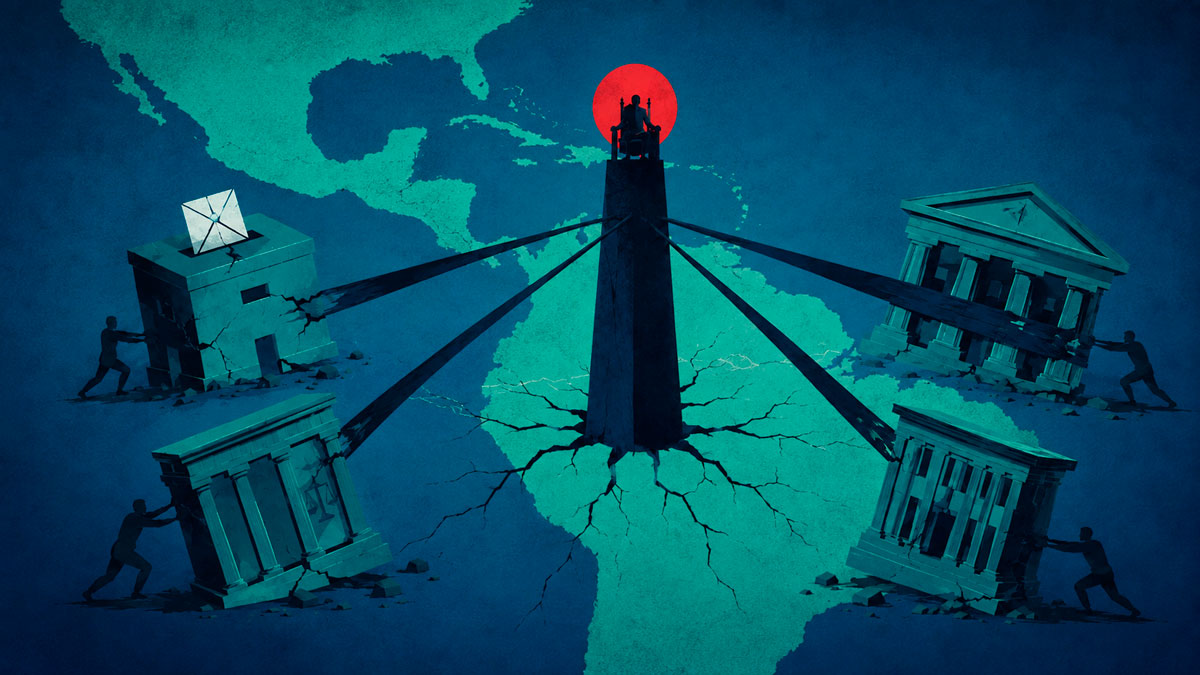
Last Friday I shared a panel with former Costa Rican President Carlos Alvarado Quesada. In response to a question from the audience, he said something that shouldn’t surprise us, but which we rarely articulate with such clarity: in Latin America there is a fervent desire for the concentration of power, because the corrupt and the anti-democratic know something fundamental—if they manage to concentrate power, it is easier to destroy democracy.
This is not a rhetorical statement. It is, in fact, the central diagnosis that political science offers today regarding how democracies die in the 21st century. They no longer fall due to military coups. They fall due to what specialists call executive aggrandizement: the progressive erosion of democracy through the gradual control of the institutions that regulate political competition. The target is no longer the military barracks, but the Constitutional Court, the Electoral Tribunal, the Public Prosecutor’s Office.
The region as a laboratory
Latin America today offers the most complete catalog of this logic in action.
El Salvador is the fastest example. In just five years, Nayib Bukele’s government removed all the justices of the Constitutional Chamber and replaced them with loyal judges, who authorized a presidential reelection that the Constitution itself prohibited. The result, documented by the V-Dem Institute, is a consolidated electoral autocracy: the ballot boxes remain, but the referees who ensured that the votes were counted fairly have disappeared.
Nicaragua shows the endpoint. The Ortega-Murillo regime is now among the ten least democratic countries on the planet, after more than a decade of the same pattern: co-opt first, repress later, and finally govern without checks and balances.
Mexico and Peru, on the other hand, remind us that this phenomenon transcends ideological boundaries. In both countries, the sustained weakening of the judiciary—under different governments and political projects—has been enough for organizations like V-Dem to classify them among the most worrying cases of autocratization on the continent.
The overall picture is compelling: according to the most recent Democracy Report, only 4% of Latin America’s population lives today under a fully liberal democracy—the cases of Chile, Costa Rica, and Uruguay. The rest inhabit fragile electoral democracies or openly autocratic regimes.
Honduras is no exception; it is an ongoing experiment.
When we look at what is happening in our own country through this lens, the pattern is recognizable. The constant struggle for control of the National Electoral Council, the deliberate paralysis of the electricity reform at ENEE, an 86% impunity rate for crimes against life: each of these issues is not an isolated problem of public administration. In each case, it involves an oversight institution that someone has an interest in capturing, weakening, or emptying of its power.
That is the real warning behind Alvarado’s reflection: Latin American populism—whether left-wing, right-wing, or without a clear ideology—doesn’t need to eliminate democracy in one fell swoop. It is enough for it to gradually remove, one by one, the institutional components that sustain it, until only the electoral shell remains.
The question we should ask ourselves
The lesson isn’t simply “let’s protect democracy” in the abstract. It’s much more concrete: whenever a government proposes to “simplify,” “unify,” or “modernize” an oversight institution—a court, a regulatory body, an auditing agency—that proposal deserves scrutiny rather than applause. Not because all institutional reform is suspect, but because the region’s recent history teaches us that this is precisely the language with which the concentration of power begins.
Costa Rica has weathered this storm better than most of its neighbors. Honduras still has time to decide which chapter of this story it wants to be written in.